
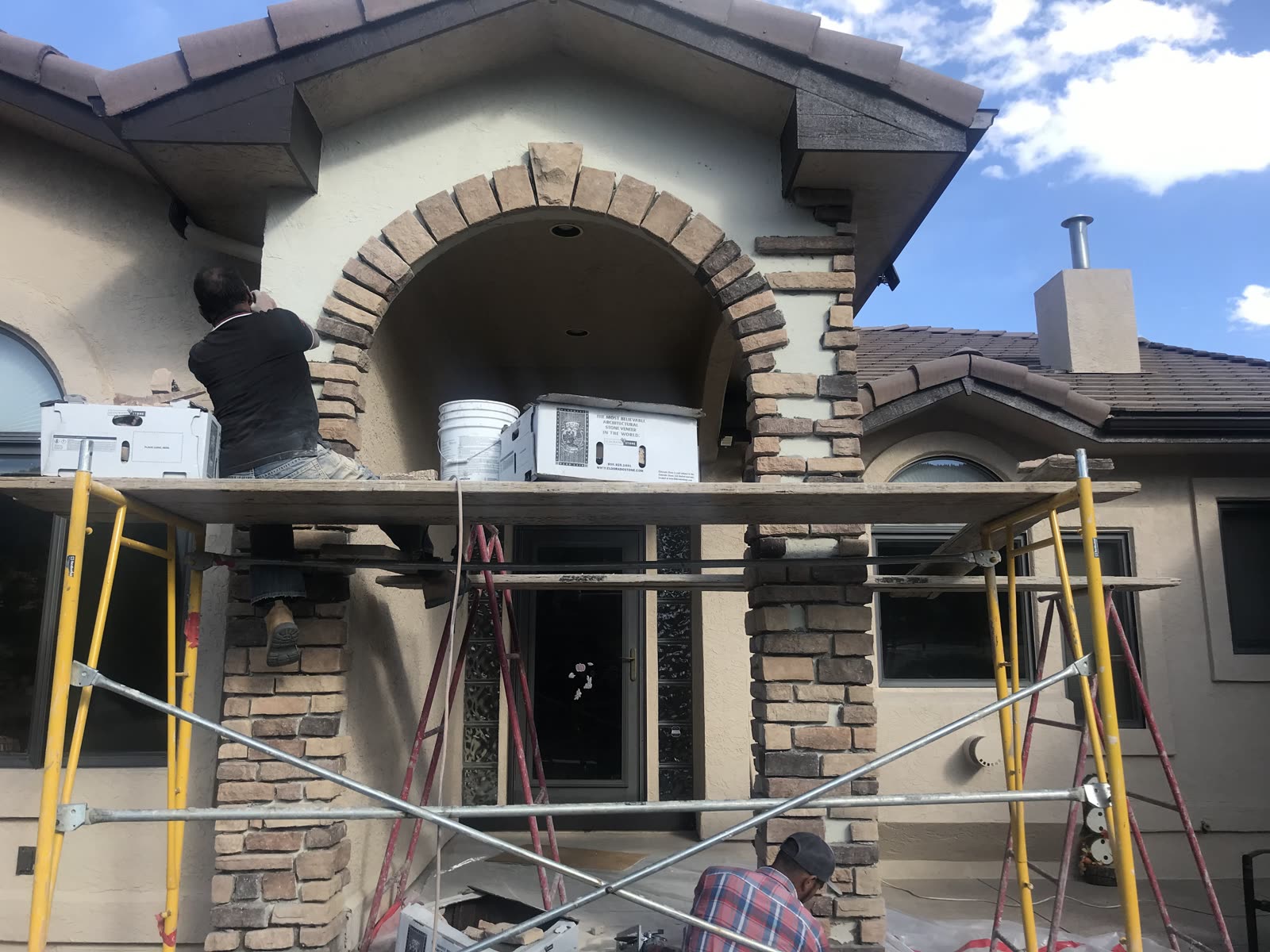
Stucco Repair in Colorado Springs Matched, Not Patched
Cracked, hollow, or crumbling stucco is not a paint problem. In Colorado Springs, high-altitude UV, forty-degree daily swings, freeze-thaw, and hail work on a wall every year until something opens up. We find why it failed, fix that first, then repair and match the texture so it does not show.
Read the crack before you patch it
Every stucco crack is a symptom. Patching without knowing the cause buys you a season, maybe two, and then the same line opens through the new material. Before we mix anything we walk the whole elevation, check what is above and behind the failure, and look for the mechanism. A crack caused by a leaking window head gets fixed at the window, not with mortar.
We tap the field with a knuckle or a handle to map delamination, probe soft spots, and pull a small test area when the wall reads wet. That tells us whether you need a surface repair, a full re-lath and three-coat rebuild of one section, or a coating. Guessing here is how a repair fails twice.
- Hairline and shrinkage cracks: fine, random, cosmetic, from the base coat curing too fast in dry Colorado air.
- Diagonal cracks off window and door corners: stress concentration, usually missing corner lath or no expansion joint.
- Stair-step or wide vertical cracks: settlement or framing movement. The wall is telling you the structure moved.
- Map cracking, a spiderweb across a whole field: a curing or bonding mismatch between base coat and finish coat.
- Delamination and hollow spots: the stucco has let go of the lath. It sounds drummy when you tap it.
- Base-of-wall crumbling: wicked ground moisture, a buried weep screed, or splash from grade set too high.
- Hail impact: round pocks and chipped finish, worst on south and west elevations after a Front Range storm.
Water gets in behind the stucco, not through it
Stucco is not waterproof and was never meant to be. It is a reservoir cladding: it absorbs, then it dries. The weather barrier behind it and the flashing at every penetration are what keep water out of the framing. Many of the failures we find in Colorado Springs start at a kickout diverter that was never installed where a roof edge dies into a sidewall, so runoff pours straight down inside the wall.
Freeze-thaw finishes the job. Water sits in a crack, freezes overnight, expands, and jacks the opening a little wider. Colorado Springs can swing forty degrees in a day through spring and fall, so that cycle runs dozens of times a season. Add a weep screed buried by regrading, or a mulch bed piled against the wall, and the base of the stucco stays damp year round and crumbles.
So we chase the water first. Head flashing, window pan flashing, kickouts, deck ledgers, roof-to-wall transitions, hose bibs, dryer vents, light blocks. If the roof itself is shedding poorly we will say so and talk about roof coating as a separate conversation. Sealing a wet wall with a patch and a coat of paint traps the moisture and makes the damage worse.
Texture matching is the whole game
A structurally perfect repair still fails the only test that matters if you can see it from the curb. Stucco texture is applied by hand, and every house has its own. Sand float, heavy or light dash, Santa Barbara smooth, lace, knockdown, worm, swirl, and the variations in between. Matching means reading the trowel work on your wall (direction, pressure, aggregate size, how tight the knockdown was pulled) and reproducing it on a sample area before it goes on the house.
Color is the second half. Integral-color stucco fades unevenly under high-altitude UV, so a fresh patch mixed to the original formula still reads brighter than the twenty-year-old wall around it. Sometimes the honest answer is that the repair gets blended and the elevation gets recoated wall to wall. Stucco painting with an elastomeric or breathable acrylic finish is often the cleanest way to make a large repair vanish.
How a stucco repair actually goes
Repair scope drives everything. A hairline field crack gets a different treatment than a delaminated section over a garage. What does not change is the sequence: diagnose, correct the water source, cut back to sound material, rebuild in the same system the wall was built in, match texture, then coat. Two coats minimum on any finish work, because one coat of anything on porous stucco is a primer, not a finish.
Cementitious repairs need moisture and time to cure. Colorado air pulls water out of a fresh patch fast, which is exactly what causes shrinkage cracking, so we damp-cure and shade the work in the dry heat of July and August. Acrylic and elastomeric finishes have their own window: surface temperature above roughly fifty degrees and rising, with no freeze in the overnight forecast.
- Cut out failed stucco back to sound, bonded material and square the edges so the patch has a clean perimeter.
- Inspect and repair the weather barrier, lath, and flashing behind the opening before anything new goes on.
- Re-lath with the correct metal, lapped shingle-style, and tie into existing lath rather than butting to it.
- Scratch and brown coat where the repair is full depth, then let it cure and shrink before the finish.
- Hand-apply finish texture to match the surrounding wall, feathered past the patch line so the edge disappears.
- Seal, prime, and apply two coats over the repair area or the full elevation, depending on how the color reads.
Hail damage and getting a straight estimate
Front Range hail hits stucco harder than most people expect. You get round impact pocks, chipped finish coat, and on synthetic systems, dented or punctured foam. The damage often reads as minor from the ground and obvious from a ladder, and it is usually concentrated on the storm-facing elevation. Every one of those pocks is an open path for water, so hail damage is a repair item, not a cosmetic one.
We give free written, itemized estimates, so you can see what is being repaired, what is being replaced, and what is only being coated. We work Colorado Springs, Monument, Castle Rock, Manitou Springs, Woodland Park, Fountain, Pueblo, Canon City, and the rest of the Front Range and Pikes Peak region. See the full service areas list, or call (719) 320-9830. If the walls also need paint, we can scope house painting in the same visit.
Common questions
Width and pattern tell you a lot. Fine random hairlines are usually shrinkage and cosmetic. Diagonal cracks running off window or door corners point to stress or missing corner reinforcement. Wide vertical or stair-step cracks suggest movement in the structure. Hollow, drummy areas mean the stucco has separated from the lath. Any crack that stays damp or shows staining is moving water and should be looked at.
Texture is matched by hand, on site. We read the trowel pattern, aggregate size, and finish style on your wall (sand float, dash, lace, knockdown, worm, or swirl) and reproduce it on a test area before touching the repair. Color is harder, because stucco fades unevenly under Colorado UV. On larger repairs the honest fix is often blending the patch and recoating the full elevation.
Because the cause was never corrected. A patch only covers the symptom. Repeat cracking in one place usually means ongoing movement, a missing expansion joint or corner lath, or water entering behind the wall through failed flashing or a missing kickout diverter. Freeze-thaw then widens the same line every winter. Fix the mechanism first and the repair holds.
Late spring through early fall is the widest window. Cement-based repairs need to stay damp while they cure, so hot, dry, windy days call for damp curing and shade. Acrylic and elastomeric finishes need surface temperatures above roughly fifty degrees with no overnight freeze coming. Small repairs can often be done outside that window when the forecast cooperates. Schedules shift with elevation across Colorado Springs, Pueblo, and Woodland Park.
A recent stucco job, wall by wall.
Cracks patched, then the whole house recoated. Pick an elevation and drag the handle.
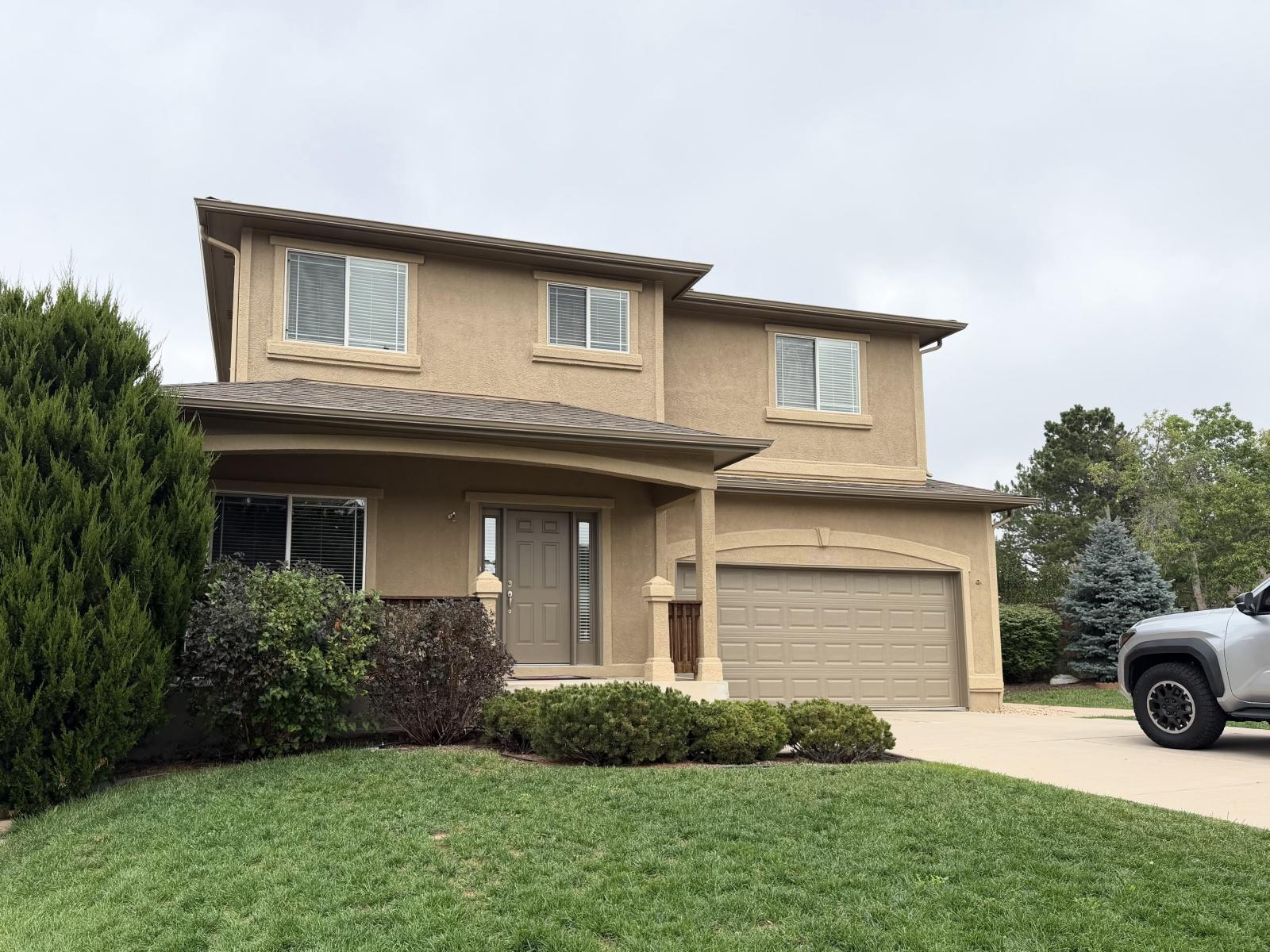
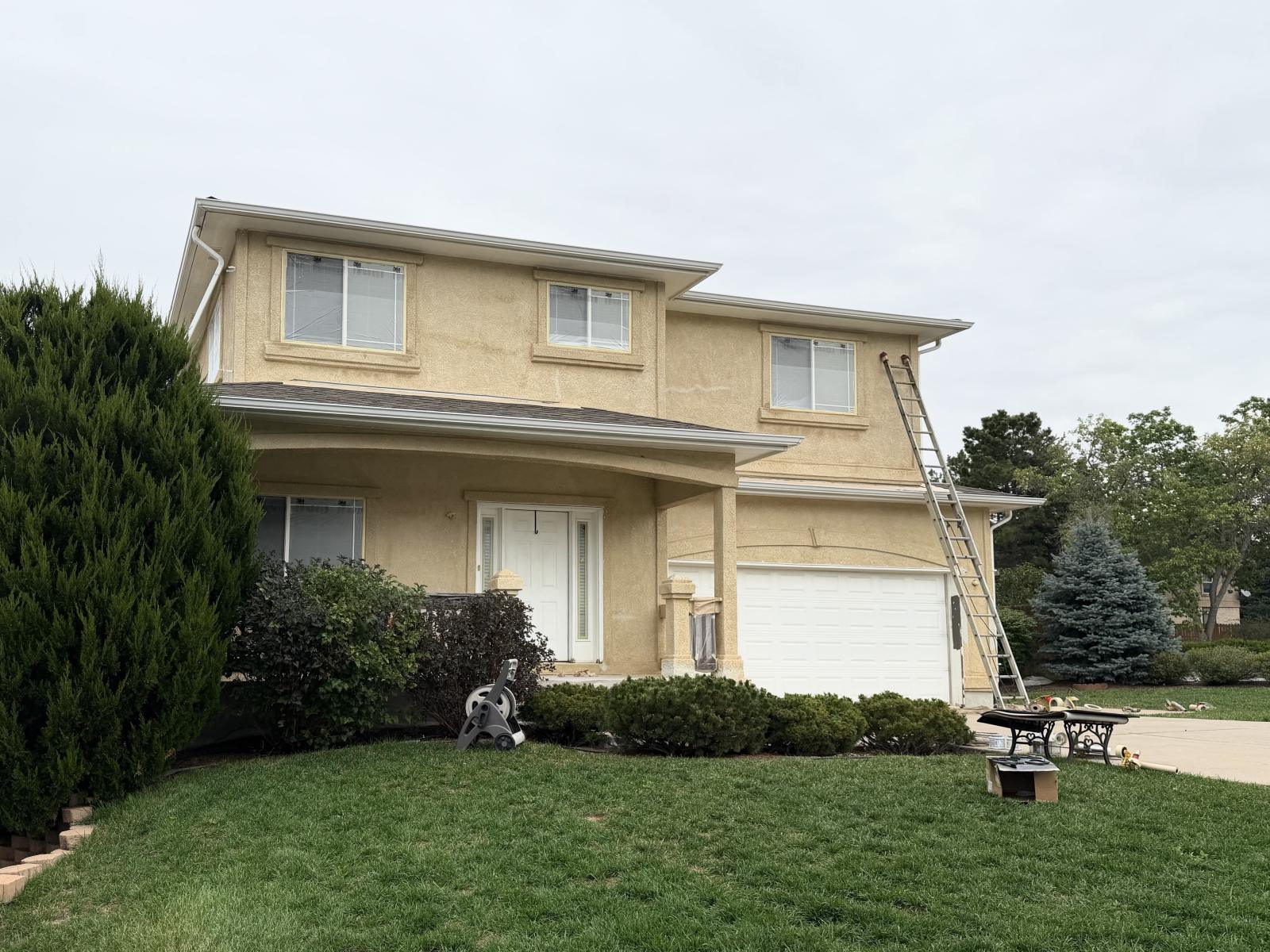
Stucco crack repair and a full repaint
- Scope
- Crack repair, full exterior repaint
- Surfaces
- Stucco body, trim bands, gutters, downspouts, doors
- Coverage
- All four elevations
- Finished
- September 2026
Pick an elevation
Get a quote
Free estimate, this week.
Tell us what you are looking at. We will come walk the property, find the cause, and leave you with a written, itemized number. No charge for the visit.
Colorado Springs, CO 80921