
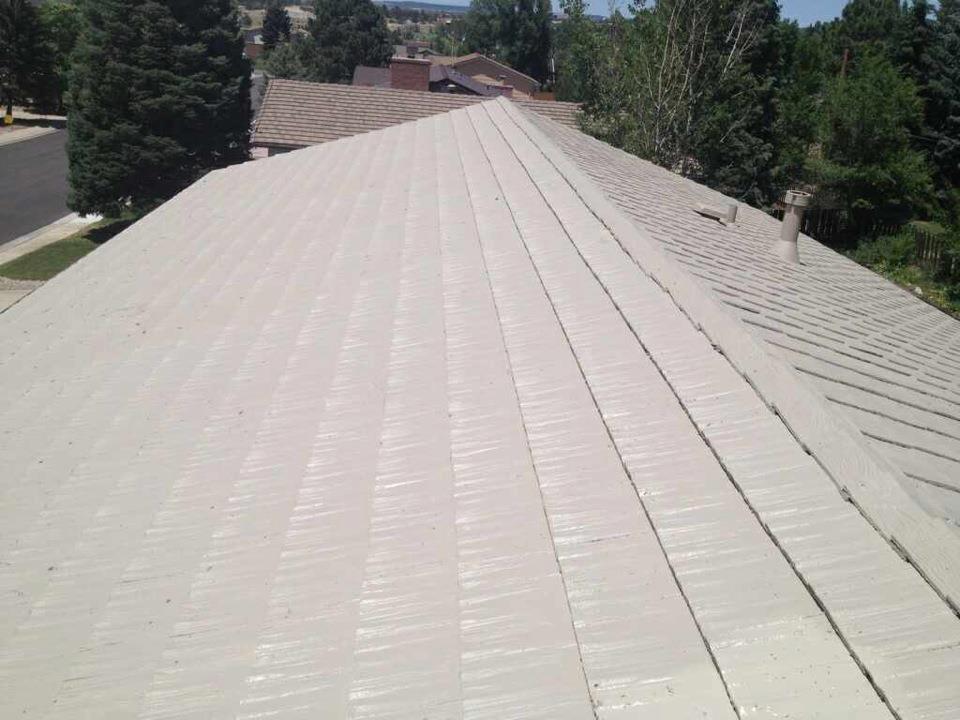
Roof Painting in Colorado Springs
A painted roof is one of the biggest color decisions on a house, and it is also one of the easiest to get wrong. Metal, tile and shingle each behave differently under Colorado sun. We tell you honestly which roofs should be painted and which should not.
What roof painting can and cannot fix
Roof painting is a coating job, not a repair. Paint changes color and adds a UV and moisture barrier over sound material. It does not stop an active leak, replace failed flashing, or add structural life to a roof that is past its service window. If a deck is soft or panels are perforated, that work comes first. We say so during the estimate rather than coating over a problem.
Roof painting and roof coating are different products for different jobs. Painting is a pigmented film built for appearance and UV protection on sloped metal and tile. Coating is a thick elastomeric membrane built to bridge seams and hairline cracks on low-slope and flat surfaces. Asking paint to waterproof a flat roof is the most common mistake we see homeowners make.
- Color change on metal, tile, and roof trim where the substrate is still sound
- UV protection over chalked or faded factory finishes
- Rust arrest on galvanized and steel panels with surface corrosion, not perforation
- Fresh color on flashing, drip edge, ridge cap, and roof-mounted vents
- Not a substitute for replacing curled, cracked, or granule-bare asphalt shingles
Metal roofs: rust, fasteners, and factory finish
Metal is the substrate that rewards prep the most. Rust has to be taken back to sound metal with a wire wheel, grinder, or sanding disc, then primed with a rust-inhibitive direct-to-metal primer before any color goes on. Coating over loose scale just hides the corrosion for a season. Under the film the rust keeps spreading and lifts the paint from below.
Factory-finished panels are the trap. Kynar and siliconized polyester finishes are engineered to shed dirt and resist chalking, which also means they resist paint. Those surfaces need washing, degreasing, and mechanical abrasion to break the gloss, then a bonding or self-etching primer rated for that finish. Skip that step and the color looks perfect for a year, then peels off in sheets.
Fasteners deserve their own line on the estimate. Exposed screws on R-panel and corrugated roofs use EPDM washers that harden and shrink under high-altitude UV. Backed-out or spun screws should be replaced with a larger-diameter fastener before coating, not painted over. The same goes for loose ridge cap and drip edge. Paint does not hold hardware down. That is the same discipline we bring to commercial painting on metal buildings around Colorado Springs and Fountain.
Tile and shingle roofs need opposite answers
Concrete tile is porous and behaves like a masonry substrate. It needs a thorough wash, removal of efflorescence and loose surface paste, and a masonry primer that penetrates rather than sits on top. Clay tile is denser and often carries a fired glaze, so adhesion is far less predictable. On glazed clay we test a section before quoting a whole roof.
Moisture is the other half of tile work. Concrete tile holds water after snowmelt, and a film that is too tight traps that vapor and pushes itself off during freeze-thaw. Breathable acrylic systems handle this better than heavy sealers. Underlayment life matters too. A tile roof with failing underlayment needs that addressed before anyone spends money on color.
Asphalt shingles are the honest no. Shingles rely on embedded granules for UV protection, and paint bridges those granules, holds heat, and traps vapor moving up through the deck. The result is curling, accelerated aging, and usually a voided manufacturer warranty. If you want a different roof color on a shingle home, replacement is the answer. Put that budget into house painting or stucco painting and you get more curb appeal for the money.
Why Colorado weather decides how long it lasts
Colorado Springs sits above 6,000 feet. UV intensity climbs with elevation, and a roof absorbs more of it than any other surface on the house. Dark metal panels can run far hotter than air temperature on a July afternoon, then drop sharply after sunset. That daily swing expands and contracts the panel under the paint film, so elasticity and adhesion matter more here than sheen.
Freeze-thaw and hail finish the test. Water that gets under a poorly bonded film freezes and lifts it. Hail dents metal and chips brittle coatings at the impact point, and that chip becomes the rust starting line. Low humidity along the Front Range also speeds flash-off, so material has to go down at the right rate or you end up with dry spray and thin film build.
Timing is part of the spec. Surface temperature has to be above the product minimum and at least five degrees above the dew point, and hot panels in direct afternoon sun can flash a coating before it levels out. Late spring through early fall is the working window from Monument and Castle Rock down through Fountain, Pueblo, and Canon City, with higher towns like Woodland Park running a shorter season.
Color, HOA approval, and what the estimate covers
Roof color drives the whole exterior. A roof reads as a large field of color from the street, so it should be chosen against the body, trim, stone, and stucco rather than off a chip held in isolation. Cooler, lighter colors reflect more heat and stay cooler under high-altitude sun. Deep colors show thermal movement and chalking sooner on metal panels.
Most Front Range neighborhoods have color rules. Subdivisions across Colorado Springs, Monument, and Castle Rock run approved palettes through an architectural committee, and Manitou Springs adds historic district review in some areas. Submit your color before work is scheduled, not after. We put the specific product and color name on the estimate so you have something concrete to hand the committee.
Every estimate is free, written, and itemized. It lists the substrate, the prep scope, the primer chosen for that substrate, and the finish system, with two coats minimum as standard practice. If part of the roof needs repair before coating, that shows as its own line instead of disappearing into a lump sum. Check our service areas or reach out to get on the schedule.
Common questions
We do not recommend it. Asphalt shingles depend on their granule layer for UV protection, and a paint film bridges those granules, holds heat, and traps vapor rising through the deck. That leads to curling and faster aging, and it typically voids the shingle manufacturer warranty. For a color change on a shingle home, replacement is the right path.
Roof painting applies a pigmented finish for color and UV protection over sound sloped substrates such as metal and concrete tile. Roof coating applies a thick elastomeric membrane that bridges seams and hairline cracks, and it is intended for low-slope and flat surfaces. The two use different chemistry and very different film thickness. Paint alone will not waterproof a flat roof.
Not always. Surface rust can be taken back to sound metal with a wire wheel or sanding disc, then locked down with a rust-inhibitive direct-to-metal primer before the finish coats go on. Panels that are perforated, thin enough to flex under hand pressure, or rusted through at the fastener holes need replacement first. Coating over loose scale only hides the corrosion.
It will if the surface is prepared for it. Kynar and siliconized polyester factory finishes are engineered to shed dirt and resist chalking, which also makes them resist paint. They require washing, degreasing, and mechanical abrasion to break the gloss, followed by a bonding or self-etching primer rated for that finish. Without that step the coating peels in sheets.
Get a quote
Free estimate, this week.
Tell us what you are looking at. We will come walk the property, find the cause, and leave you with a written, itemized number. No charge for the visit.
Colorado Springs, CO 80921