
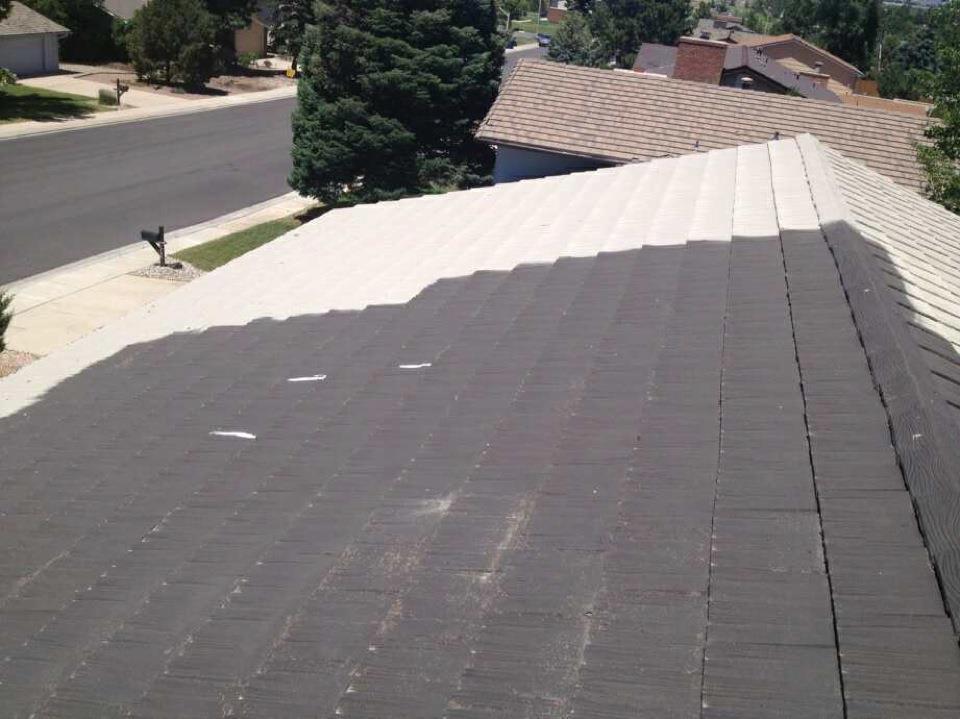
Roof Coating in Colorado Springs
Flat and low-slope roofs in Colorado Springs take a beating. High-altitude UV, hail, and forty-degree swings between afternoon and midnight pull seams apart and dry membranes out. A reflective elastomeric roof coating seals those weak points and buys years of service life without a full tear-off.
What a roof coating actually does
A roof coating is a liquid-applied membrane. It goes down in coats, cures into one continuous sheet, and bonds to the roof already there. Elastomeric means it stretches. A good acrylic or silicone film can move several hundred percent of its own dimension without splitting, which matters on a roof that expands all afternoon and shrinks hard after sundown.
That is the whole point at 6,000 feet. Colorado Springs runs thirty to forty degrees of swing between a July afternoon and the next morning. Every joint on a flat roof works back and forth through that cycle, every day, all season. Rigid patch material cracks at the edges. A coating that moves with the deck does not.
Ponding water, seams, and flashings
Flat roofs are not flat. They are low-slope, usually a quarter inch of fall per foot, and after a few years of deck deflection they hold water in spots. Ponding is where coatings fail first, because standing water finds any pinhole and works under the film. We check drainage before we quote. Low areas get built up, drains get cleared, and the ponding zones get a coating chemistry that tolerates standing water.
Seams, penetrations, curbs, and the wall-to-roof transition are the other failure points. Those get polyester reinforcing fabric embedded in wet base coat, then a second pass over the top, so the detail is three layers thick where the roof moves most. Skipping fabric is the fastest way to get a coating that looks finished on day one and splits open by the second spring.
- Drain bowls, scuppers, and overflow paths cleared and checked for standing water before any coating goes down
- Seams and laps bridged with polyester fabric set into wet base coat, not painted over dry
- Pipe boots, vents, curbs, and skylight edges detailed by hand ahead of the field coats
- Wall-to-roof transitions and parapet caps carried up and terminated so wind-driven rain cannot get behind the film
- Rusted metal fasteners and seams primed before coating so corrosion does not keep spreading underneath
Reflectivity, attic heat, and UV
UV at this elevation is roughly twenty to twenty-five percent stronger than at sea level, and it is the main thing that kills a roof membrane. Asphalt and modified bitumen go brittle as their oils bake out. A white reflective coating pushes most of the solar energy back off the roof instead of letting it soak into the substrate, so the membrane underneath runs cooler and ages slower.
You feel the difference inside. A dark low-slope roof can run well over 150 degrees on a clear July afternoon, and that heat drives straight into the deck and the space below. Reflective coatings cut peak surface temperature substantially, which takes load off the cooling system and off any HVAC equipment sitting on the roof. Buildings with living space directly under the deck notice it most.
Matching the coating to the roof you have
Substrate decides chemistry. Modified bitumen and built-up asphalt usually take an acrylic system over a bleed-blocking primer, because raw asphalt oils will stain through a white coating otherwise. EPDM needs a wash and a primer made for cured rubber or nothing sticks. Metal panels need rust treatment, fastener checks, and seams reinforced before any field coat. Spray polyurethane foam needs a coating heavy enough to protect the foam, since bare foam breaks down in sunlight fast.
Silicone and acrylic are not interchangeable. Silicone handles ponding water and holds up through long wet periods, but it does not accept most other coatings later, so every recoat has to be silicone again. Acrylic breathes, recoats cleanly, and is easier to maintain over time, but it does not want to sit in standing water. We pull a test patch and check adhesion before committing to either one.
- Modified bitumen and built-up asphalt: bleed-blocking primer first, or asphalt oils stain through the white topcoat
- EPDM and cured rubber: washed, then primed with a product rated for the membrane, never coated bare
- Metal panels: rust treated, loose fasteners replaced, every lap seam reinforced before the field coats go on
- Spray polyurethane foam: recoated at a thickness that protects the foam from UV, not just tinted
- Previously coated roofs: existing product identified and adhesion tested, since silicone and acrylic will not bond to each other
Coating or tear-off, and where we work
A coating is not a fix for a roof that is already wet. If the insulation under the membrane is saturated, or the deck is soft, that section has to come out first. Coating over trapped moisture blisters in the first hot week. Where the substrate is sound and the failures are at seams, edges, and UV damage, a coating restores the surface and adds years without the disposal, noise, and exposure of a full tear-off.
We coat roofs across Colorado Springs and out through Monument, Castle Rock, Manitou Springs, Woodland Park, Fountain, Canon City, and Pueblo. Pitched shingle and tile roofs are a different scope, covered on our roof painting page, and flat-roofed retail and office buildings usually get bundled with commercial painting so the whole envelope gets handled in one trip. Full town list is on our service areas page.
Every estimate is free, written, and itemized, so you can see substrate, square footage, detail work, and coats broken out instead of one lump number. Two coats is our minimum on any coating job. Call (719) 320-9830 or use the contact form and we will get on the roof and take a look.
Common questions
It depends on the system, the mil thickness applied, and how much ponding water the roof holds. Reflective elastomeric coatings are maintenance systems, not permanent ones, and they are designed to be recoated rather than torn off. Colorado conditions, high-altitude UV, hail, and daily freeze-thaw cycling, shorten the interval compared with milder climates. Annual inspection of seams and penetrations is what actually protects the investment.
Only after the leak is found and repaired. A coating seals the surface, it does not dry out what is already trapped underneath. Wet insulation and soft decking have to be cut out and replaced first, or the moisture turns to vapor in summer heat and blisters the new film. A moisture survey or core cut tells you how far the damage runs.
Late spring through early fall is the working window. Most coatings need the surface above about 50 degrees and rising, with a dry period before and after application so the film can cure without rain or overnight condensation on it. Afternoon thunderstorms are the real scheduling problem here, so work usually starts early and stops before the storms build.
No coating makes a roof hail proof. What an elastomeric film does is stay flexible instead of going brittle, so small impacts tend to dent or mark rather than crack the surface open. Large hail can still cut through to the substrate, and that damage should be inspected and repaired promptly. Coatings also make patching straightforward, since the repair is the same material.
Get a quote
Free estimate, this week.
Tell us what you are looking at. We will come walk the property, find the cause, and leave you with a written, itemized number. No charge for the visit.
Colorado Springs, CO 80921