
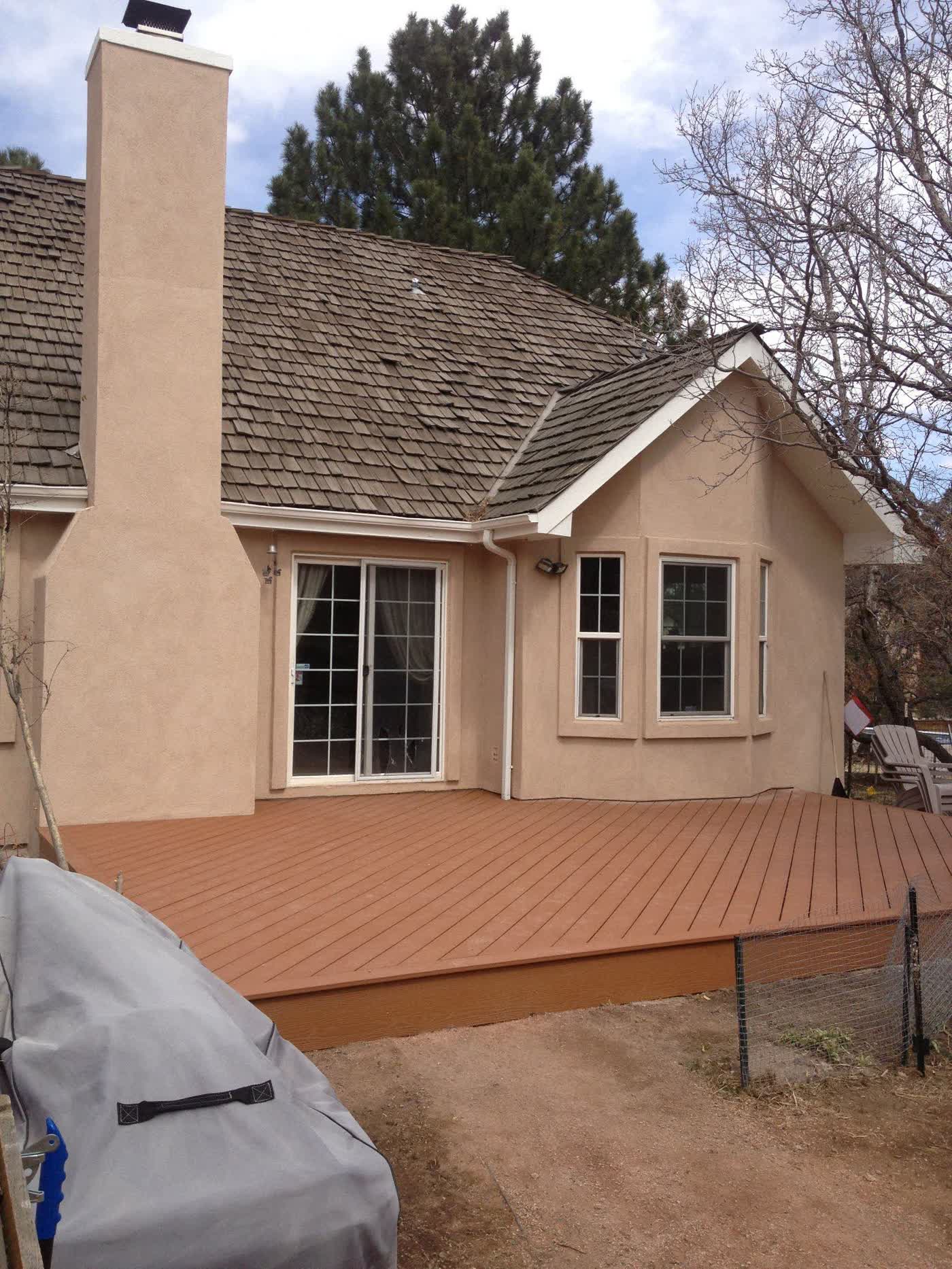
Deck Painting in Colorado Springs
Deck painting in Colorado Springs is not house painting laid flat. A walking surface takes near vertical UV, standing snowmelt, and freeze and thaw cycles that pop coatings off wood from underneath. Getting it right starts with picking the correct film build, then prepping the wood to hold it.
Why deck paint fails faster than house paint
A deck floor and a wall are not the same job. Siding sheds water and takes sun at a glancing angle. A walking surface holds standing water, snow, and ice, and takes near vertical UV for hours a day. Add boot grit, furniture legs, and dog nails, and the same coating that lasts years on a wall can be chalking and peeling on a deck in a season or two.
Colorado Springs makes it worse. At roughly 6,000 feet the UV load is meaningfully higher than at sea level, and towns like Monument and Woodland Park sit higher still. Then comes freeze and thaw. Water finds a hairline crack or an unsealed board end, freezes overnight, expands, and lifts the film off the wood from underneath. That is the classic Front Range deck that peels in sheets while the painted siding above it still looks fine.
Solid color, semi-transparent, or penetrating
Three families of product, three different failure modes. Solid color deck paint and solid stain build a film on top of the wood. Best color retention, best at hiding weathered or mismatched boards, and the most UV protection because the pigment load is highest. The catch is that a film can peel. When it does, the fix is scraping and sanding, not just another coat.
Semi-transparent stain carries less pigment and sits mostly in the wood with only a thin surface film. It fades instead of peeling, so the recoat is a wash, a brightener, and another application. Penetrating stains build almost no film at all. They soak in, wear off in the traffic lanes, and need refreshing sooner, but they never strand you with a stripping job.
That is the whole tradeoff. Film build buys you color life and hiding power, and charges you back at recoat time. It is also close to a one-way door. Once a deck has worn a solid film, going back to semi-transparent means stripping and sanding to bare wood. We will tell you which direction your deck is already committed to before you pick a color.
- Solid color paint or solid stain: maximum hiding and color life, peels when it fails, recoat means scraping.
- Semi-transparent stain: partial hiding, fades rather than peels, recoat is wash, brighten, and reapply.
- Penetrating stain: no meaningful film, wears in the traffic lanes, shortest interval but simplest upkeep.
- Any solid film on a deck floor is close to permanent; reversing it means stripping back to bare wood.
Railings and floor boards are two different jobs
A railing is a vertical surface. It sheds water, takes glancing sun, and nobody walks on it. A floor board is horizontal and takes everything. Treating both with the same product on the same schedule is why so many decks look half failed, with crisp posts above a blotchy, peeling walking surface. We usually spec the two separately.
A common setup: solid color on rails, posts, balusters, skirting, and fascia so the deck reads as trim and matches the house, then a lower film product on the boards you actually walk on. The rails hold their color for years. The floor gets refreshed on its own cycle without anyone having to mask, scrape, or repaint the whole structure.
Slip resistance belongs in this conversation. A smooth paint film on a horizontal surface gets slick when it is wet or frosted, and Colorado Springs decks are frosted a lot of mornings. Fine aggregate mixed into or broadcast into the walking surface topcoat fixes that. Heavy texture holds dirt and is unpleasant barefoot, so we keep the grit fine and keep it off the rails.
Prep decides how long deck paint lasts
Coatings do not fail in the middle of the film. They fail at the bond line. So the work that matters happens before anything gets opened: wash off dirt, pollen, mildew, and old chalk; scrape and sand every loose edge back to sound material; feather the transitions so you do not telegraph a ridge; and rinse any stripper or brightener fully so nothing is left behind to interfere with adhesion.
Moisture content is the item most crews skip. Wet wood will take a coating and then push it off later. Most manufacturers want the boards under about 15 percent, and a meter answers that in seconds. Pressure washing too hard is its own problem. It raises and fuzzes the grain on softwood, and that fuzz is a weak layer sitting between your new coating and the deck.
Two more things. End grain drinks water like a straw, so cut ends, board ends, and the gaps packed with pine needles get cleaned and sealed. And paint does not fix carpentry. Rotted boards, popped fasteners, split rails, and soft framing are deck restoration work, and they get handled before a coating goes on, not after.
Timing deck painting around Colorado weather
Surface temperature, not air temperature, controls the window. Most deck products want the boards between roughly 50 and 90 degrees while you apply and for hours afterward. At 6,000 feet a dark deck in direct afternoon sun can blow past the top of that range on a mild day, which flash dries the film and leaves lap marks and poor penetration. We follow the shade and start early.
The other end of the day matters just as much. Front Range nights drop hard, and dew can form on a deck well before midnight. A film that has not set up when moisture lands on it can blush, stay soft, or lose adhesion. Late season work in Monument, Woodland Park, and Castle Rock gets scheduled tighter than the same job in Pueblo, Fountain, or Canon City for exactly that reason.
Dry to touch is not cured. A deck can be walkable in a day and still be weeks from full hardness. Furniture, planters, and mats put back too early imprint the film and trap moisture under themselves. We tell you the specific timeline for the product on your deck. Check our service areas or get a free written estimate.
Common questions
It depends on the deck's condition and how you want to maintain it. Solid color paint hides weathered, mismatched boards and holds color longest, but it builds a film that eventually peels and needs scraping. Semi-transparent and penetrating stains fade instead of peeling and recoat easily, but they show the wood's defects. If a deck already carries a solid film, going back usually means stripping to bare wood.
A deck floor is horizontal. It holds standing water, snow, and ice instead of shedding them, and it takes sunlight at close to a right angle for hours. Water that works into a crack or an unsealed board end freezes overnight in Colorado, expands, and pushes the coating off from underneath. Foot traffic and grit abrade whatever survives. Siding faces none of that.
Yes. A smooth coating film on a horizontal surface gets slick when wet or frosted. Fine aggregate can be mixed into the walking surface topcoat or broadcast into it while it is still wet, which restores traction without changing the color. Grit size matters. Coarse texture grabs well but traps dirt and feels rough barefoot, so it is normally kept fine and kept off railings.
Fox Coatings and Exteriors works out of Colorado Springs and serves the surrounding Front Range, Pikes Peak, and Pueblo area communities, including Monument, Castle Rock, Manitou Springs, Woodland Park, Fountain, Pueblo, and Canon City. Office hours are Monday through Saturday, 7 AM to 7 PM. Call (719) 320-9830 or email [email protected] for a free written, itemized estimate.
Get a quote
Free estimate, this week.
Tell us what you are looking at. We will come walk the property, find the cause, and leave you with a written, itemized number. No charge for the visit.
Colorado Springs, CO 80921